Summary: About half of products fail EMC testing the first time. That figure comes from an Intertek white paper, and test labs still quote it. On the second attempt, the same paper puts failures at only 5 to 7%. This post looks at what the number does and doesn’t tell you, the causes the paper names, why the second attempt passes so much more often, and what a first-time pass takes in practice: a pre-scan on the first working prototype, the real product setup in the test, an agreed list of standards, and margin.
Where the 50% comes from
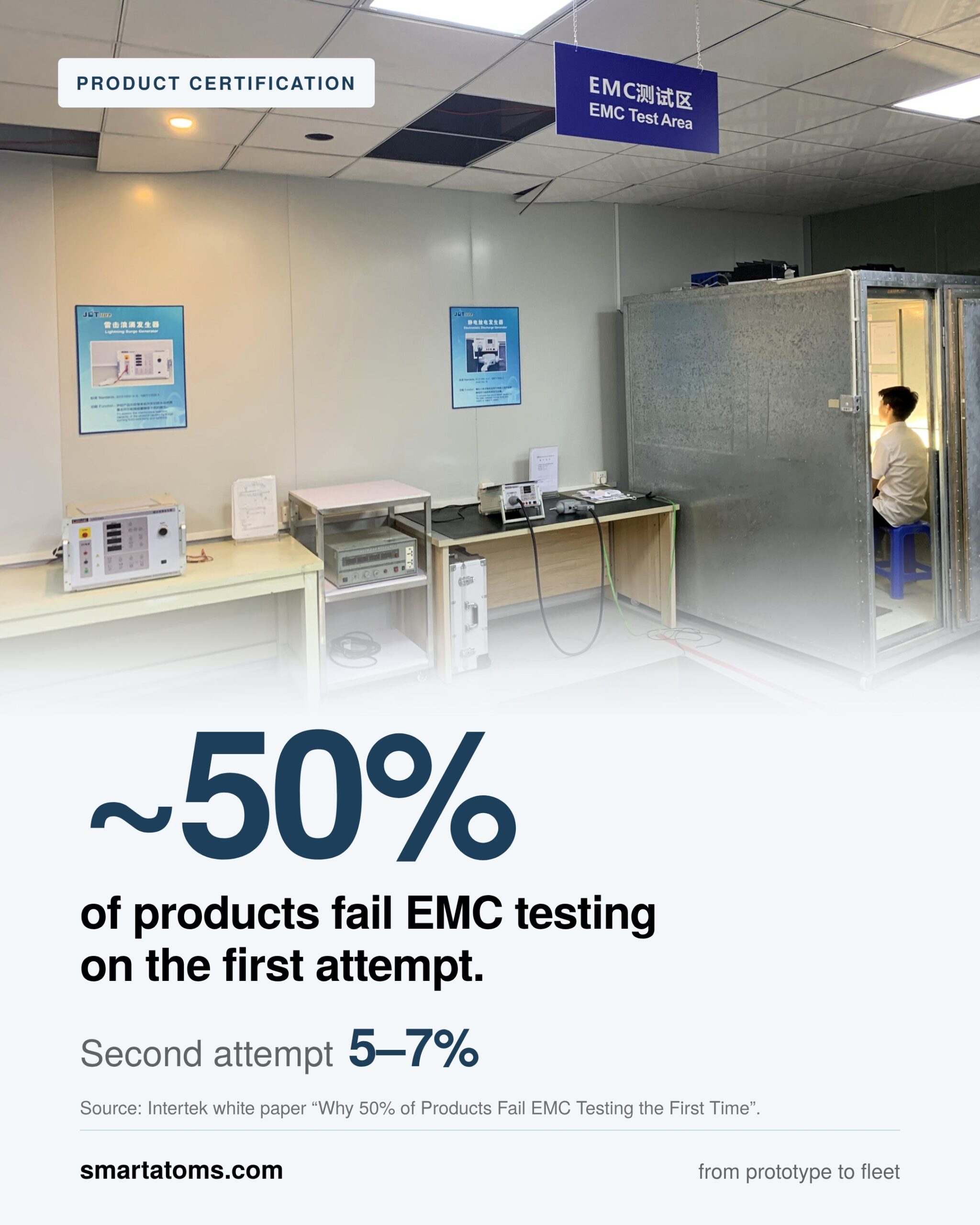
The figure is from an Intertek white paper by Roland Gubisch, “Why 50% of Products Fail EMC Testing the First Time”. Intertek runs test labs, so it sees a lot of first attempts. The headline is simple: roughly one product in two fails its first EMC test. On the second attempt, the paper puts the failure rate at 5 to 7%.
A caveat belongs right next to that number. It is a test lab’s estimate, not a study with a published method, and it has been repeated for years. We don’t know how the products were counted, which standards they were tested against, or how “fail” was defined. So treat it as a rule of thumb, not a statistic. It is still a useful one, because anyone who has taken a product to an EMC lab will recognise it.
What the paper names as the causes
The paper lists four reasons products fail the first time:
- EMC principles not applied in the design. Grounding, return paths, filtering and shielding were left for later, or not considered at all.
- Not enough EMC knowledge in the team. Nobody on the project has been through the process often enough to know where the problems usually hide.
- The wrong standards or test levels applied. The product was designed against one set of requirements and tested against another.
- Parts of the circuit interacting in ways nobody predicted. Each block works on its own; together, one disturbs the other.
None of these is about bad luck in the chamber. Three of them are decided long before the lab: in the design, in the team, and in the test plan. The fourth is exactly what a measurement on a real prototype is good at finding.
The gap between 50% and 5 to 7%
The interesting part of the paper is not the first number. It is the gap between the two. If half of products fail the first time and only 5 to 7% fail the second time, something changes between the attempts.
What changes is knowledge. After a failed test, the team knows where the problem is: which frequency, which cable, which port, which test. The fix is usually targeted, and the second attempt passes. The product didn’t become better at EMC by chance. The team stopped guessing.
That is the whole argument for testing early. A pre-scan gives you the same knowledge before the expensive attempt, while the design can still change cheaply. The second attempt’s pass rate is available on the first attempt, if you measure first.
What a first-time pass takes in practice
From our own certification work on connected products, four things make the difference:
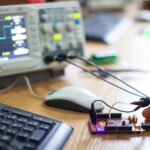
- A pre-scan on the first working prototype. In a low-cost chamber or with near-field probes on your own bench. It won’t certify anything, but it shows where the board radiates and how much margin you have, while a layout change is still a normal part of the next revision.
- The final enclosure, cables and power supply in the test. Not a development-board setup on the bench. Cables are antennas, an enclosure changes how the board couples to the world, and a different power supply brings its own emissions. Test what you will ship.
- The standards list agreed with the lab before booking. Which standards, which test levels, which product category. This removes the cause the paper calls “the wrong standards or test levels applied”, and it costs one conversation.
- Margin. Aim well below the limit, not just under it. Units vary in production, cables get routed differently, and the lab’s setup is not your bench. A result that only just passes on a pre-scan is a result that may fail in the chamber.
What a failure costs
When you’re preparing for CE or FCC requirements, a failed test can mean a board redesign or a firmware fix. Either can put your launch date at risk. A redesign means a new board revision, new parts and a new round of tests. A firmware fix is faster, but it still needs a new build, a retest and, if devices are already in the field, an update.
We’ve dealt with both while building connected products. That’s why we test early, while there’s still time to change the design and retest. Two examples from our own work:
- What we check on the first board layout, so that certification isn’t decided by accident months before the lab.
- An ESD failure we fixed in firmware: the protection did its job, and the device still failed the test.
Before you book the lab
A short check, based on the causes above:
- Has the first working prototype had a pre-scan, and do you know your margin at the worst frequencies?
- Will the test use the final enclosure, the real cables and the power supply you will ship?
- Is the list of standards and test levels agreed with the lab in writing?
- Does someone on the team have hands-on EMC experience, or do you have access to someone who does?
- If the test fails, do you know whether the fix would be in the layout, the enclosure or the firmware?
If any answer is “no”, that is the cheapest place to start.

How we help
At Smart Atoms we prepare products for certification, from the first layout to the lab report. We design electronics with EMC in mind from the first schematic, run pre-scans on early prototypes, and support the CE, RED and FCC process through to the test reports. See our CE, RED and FCC certification service. If your product is heading for its first EMC test, talk to an engineer.
Source: Roland Gubisch, “Why 50% of Products Fail EMC Testing the First Time”, Intertek white paper. A test lab’s estimate without a published method; treat it as a rule of thumb. Practice notes: Smart Atoms, from certification work on connected products.