Firmware Build Automation
From firmware built by hand on a developer’s PC to an automated Jenkins pipeline on infrastructure we set up for you, on Hetzner or the cloud of your choice: every commit builds and tests itself, every release is signed and reproducible, and every build comes with an SBOM and CVE monitoring, so you can patch devices in the field in days.

Devices online in our own fleet
Defect rate in volume production
Secure OTA releases
Countries our devices ship to
Before: builds on a developer's PC
Many sensor and device teams built firmware v1.0 by hand on one engineer’s laptop and never needed to rebuild it for the entire product lifetime. The EU Cyber Resilience Act changes that: reporting of actively exploited vulnerabilities applies since 11 September 2026, and the full regulation from 11 December 2027.
One PC can build it
The toolchain, vendor SDK and settings live on one machine. If that engineer or laptop is gone, nobody can rebuild the binary that shipped.
Years of patches ahead
Devices in the field need security fixes for 10 to 15 years, longer than any developer PC or build setup lasts.
Manual steps, no record
Building, testing and releasing are done by hand, so nobody can say exactly what went into a release.
No answer to a CVE
Without an SBOM you can't tell whether a new vulnerability affects your firmware, or ship a fix quickly.
How it speeds up your product
Less risk from day one
The pipeline follows the release process behind 250 OTA releases to our own fleet, so your team doesn't start from an untested setup.
Your team stays on the product
Our engineers do the migration, so your product team keeps working on features. Afterwards, builds and releases run by themselves instead of taking an engineer's day.
Weeks, not months
From PC builds to a working Jenkins pipeline, and your first patch release through it, in about four weeks.
Yours to keep, or we run it
Jenkins runs on infrastructure you own, on Hetzner, your cloud or your servers, with the pipeline, scripts, documentation and training. If you prefer, we keep supporting it: updates, backups, monitoring and help when a build breaks.
After: automated in Jenkins
The same firmware, now built, tested and released by a Jenkins pipeline, with a record of every component in every build.
Jenkins infrastructure set up for you
We set up and secure the Jenkins controller and build agents on Hetzner Cloud, AWS, Azure or Google Cloud, or on your own servers. You own the infrastructure and the access.
Build containers next to your source
The toolchain and vendor SDK are pinned in tagged containers stored with your code, so any version rebuilds to the same binary, even years later.
Every commit built and tested
Jenkins builds each commit and runs static analysis and unit tests automatically; broken builds are caught before they reach a release.
Signed releases from tags
Release builds run only from version tags: versioned, signed firmware images and release notes, without manual steps.
SBOM for every release
The vendor SDK, RTOS and libraries are listed in a machine-readable SBOM that Jenkins produces with each build.
CVE monitoring and patches in days
New vulnerabilities are checked against your SBOM, with triage of what really affects your product and a documented path to a tested, signed patch.
From PC to Jenkins in four steps
1. Capture the PC build
We take the shipped version off the developer's PC and reproduce it exactly in a pinned, containerised toolchain.
2. Set up Jenkins
We set up the Jenkins infrastructure on Hetzner or the cloud of your choice and move the build onto it; every commit is built and tested.
3. Add SBOM and CVE monitoring
Jenkins produces an SBOM for every build, and you get alerts when a new CVE affects it.
4. Hand over
Documentation, training, and your first patch release through the Jenkins pipeline.
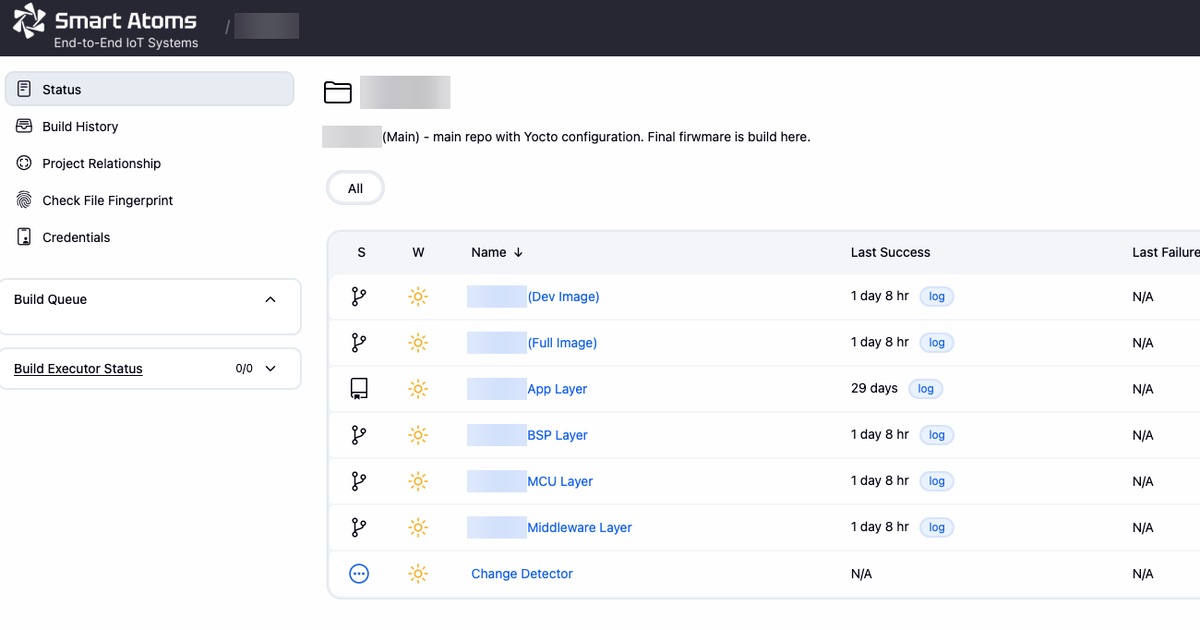
Our own Jenkins
The setup we bring to your product: firmware images and Yocto layers (BSP, app and MCU) built and tested by Jenkins on every change. Project names are blurred.
Supported platforms
Jenkins on Hetzner Cloud, AWS, Azure, Google Cloud or your own servers, for MCU firmware on NXP, ST and Nordic and for embedded Linux with Yocto or Buildroot. Why Jenkins: it is self-hosted, mature, and many teams already run it; containers keep its builds reproducible. Optional: automatic flashing and tests on a hardware test bench (HIL), and ongoing support of the Jenkins infrastructure after the hand-over. Tell us about your stack.
Planning something similar?
Tell us where you are. A senior engineer replies within one business day.

Talk to an engineer, not a salesperson
Idea, prototype, production or a fleet in the field: tell us where you are. A senior engineer replies within one business day.
Your benefits:
- Senior embedded engineers
- Hardware, firmware and cloud
- From prototype to fleet
- Clear scope and next steps
- Direct technical answers
- No sales pitch
What happens next?
A free 30-minute call with a senior engineer
A short technical discovery
A proposal with scope, timeline and cost