Summary: electronica opens in Munich on 10 November, a year after the memory market changed under every device maker: RAM prices jumped, low-capacity eMMC lead times stretched to months, and manufacturers are retiring older memory lines. A product designed now has to stay buildable for five years or more, and the EU Cyber Resilience Act expects security updates for its whole support period. One question tells you more about a memory chip or a system-on-module than its datasheet does: if I design your part in today, can I still buy it in 2031? Here are five follow-up questions that get a real answer, whether you walk the halls in Munich or follow the show from your desk.
Why this question matters this year
A datasheet describes a part as it is today. It says nothing about whether you can order it when your second production run is due, or in the fifth year of a product’s life. Over the past year, the memory market gave device makers a hard lesson in that difference:
- RAM prices jumped. A bill of materials that was approved in the spring does not look the same in the autumn, and a price you cannot plan around is a product risk, not only a purchasing one.
- Low-capacity eMMC lead times stretched to months. The small, cheap parts that many embedded products use are not the ones suppliers prioritise when demand rises.
- Older memory lines are being retired. Makers move their capacity to newer technology, and the parts that ship a product today can be on an end-of-life list tomorrow.
A connected device designed now has to be buildable for five years or more. It also has to be supportable for that long: the Cyber Resilience Act expects security updates for the whole support period a manufacturer declares. A part that disappears in year three does not only cost a redesign. It can force a new hardware revision, a new validation run and a new round of certification, on a product that is already in customers’ hands.
Five questions to ask, part by part
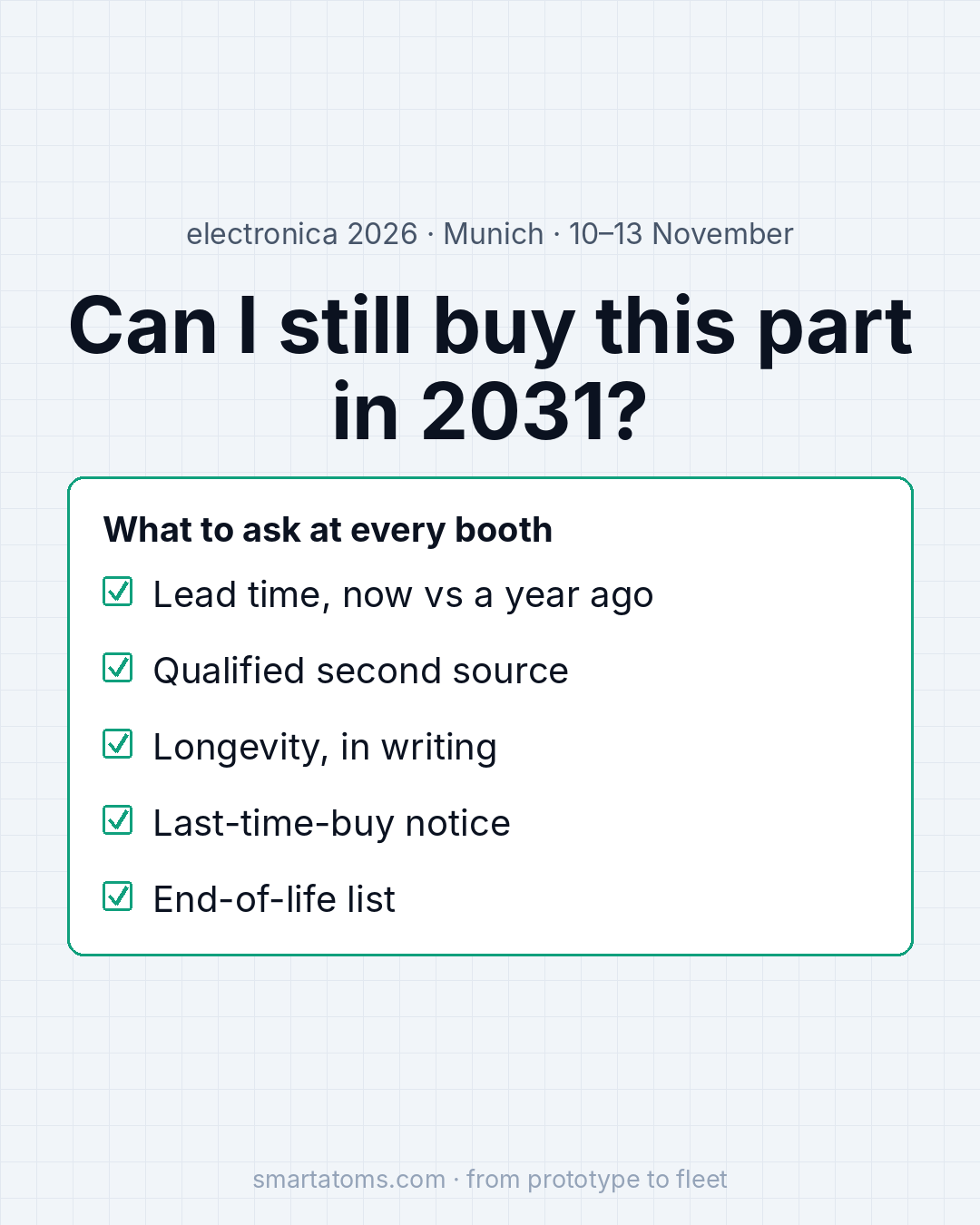
Take these to every memory and SoM booth, and ask them for each part on your bill of materials that your product cannot run without:
- What is the lead time today, and what was it a year ago? The gap matters more than the number. A supplier whose lead time has grown a lot is telling you how much slack the market has left.
- Is there a pin-compatible second source, and has anyone qualified it? A second source that exists on paper but was never tested in a real design is not a second source. Qualifying it takes engineering time, so it is cheaper to do before you are short of parts.
- How long is the longevity programme, in writing? “We plan to support it for years” is a sales answer. A number of years in a document you can point to later is a commitment.
- How much last-time-buy notice do customers get? When a part is discontinued, the notice period decides whether you can buy enough stock to bridge to a redesign, or whether you find out when the next order bounces.
- Which of the older parts are on the end-of-life list? Ask about DDR3, low-density eMMC and NOR flash by name. These are the parts many existing designs still depend on.
Who should ask whom
The five questions also show who should ask whom. Memory makers talk to those who buy memory in volume: SoM vendors and OEMs designing chip-down. Most device makers buy a SoM, so the questions belong with the SoM vendor, and they matter most while you are still choosing the module:
- Lead time now vs before the shortage. That baseline shows what normal looks like once RAM supply settles, and comparing variants shows which one the shortage hit least.
- Second source. A standard like SMARC lets you move to another vendor’s module, or at least choose a pin-to-pin SoM family so you can switch to a module with a different SoC or memory without a new carrier board.
- Longevity. Does it cover the memory, or only the SoC?
Two SoMs built on the same SoC can carry DDR4 or LPDDR4, and today those are very different risks: DDR4 is being phased out, and one module maker reported LPDDR4 cost up ~7x in a year. A product page rarely shows that.
What a good answer sounds like
You are not looking for a salesperson to say yes. You are looking for specifics. A good answer names a number of years and the document it comes from. It names the second source and says who qualified it. It gives the notice period for a last-time buy in months. A vague answer is also information: it tells you which parts to treat as a risk in your own planning.
If you get a straight answer to any of the five this week, share it with us so that others building connected devices can compare. Supply conditions differ by supplier and by part, and a few honest data points from the show floor are worth more than a general market report.
From the question to a design decision
The answers are only useful if they change what you design. Three habits help:
- Put the supply status next to each part in the bill of materials. Lead time, longevity commitment and second source, one row per critical part, reviewed on a schedule instead of when something goes wrong.
- Design the memory interface so that a second source drops in. Footprint, voltage, timing and boot behaviour are easier to keep compatible at the start than to fix after launch. Our posts on moving from an SD card to eMMC and on catching used RAM in new devices cover two of the places where memory choices catch teams out.
- Treat the support period as a design input. If the product has to receive security updates for years, the memory and the system-on-module underneath it have to be available, and large enough to carry those updates, for the same length of time.
On the update side, our fleet gives us a useful reference. On LaMetric we have shipped 250 releases over the air to about 75,000 devices that are online. Every release has to fit the memory and storage the product shipped with, so the hardware choice made at the start sets what the product can receive for its whole life.

How we help
At Smart Atoms we review bills of materials for the parts that could stop a production line: lead time, second sources, longevity commitments and end-of-life exposure, before the design is frozen. If you want that view on your own product, see how we approach component lifecycle and supply risk reviews and bill-of-materials cost reduction, or talk to an engineer. To see where your product stands on the support-period side, take the 5-minute CRA readiness check.
Which part would you ask about first?
Source: electronica 2026, 10 to 13 November, Messe München (electronica.de); Smart Atoms experience from reviewing bills of materials and running the LaMetric fleet.