Summary: A firmware update is the one feature that can fix every other bug or break every device at once. The difference is the release pipeline: how builds are signed, how a rollout is staged, how fast it can be stopped and whether devices can roll back by themselves.
What happened
According to Samsung, as reported in Korea on 23 September 2026, an internal test firmware went out with a regular update to Bespoke AI refrigerators. Owners saw offline devices, stuck update screens and spoiled food, two days before a national holiday. Samsung stopped the rollout and sent engineers for free repairs.
The bug isn’t the interesting part
Every engineering team ships bugs. The questions that matter are different: how did a test build reach customers at all, and why did it reach so many devices before anyone stopped it? Both are answered by the release pipeline, not by testing alone.
The gates we put between a build and the fleet
Separate signing keys for test and production
Test and production builds are signed with different keys. A production device rejects a build that isn’t meant for it, so a test build cannot install even if it is published by mistake.
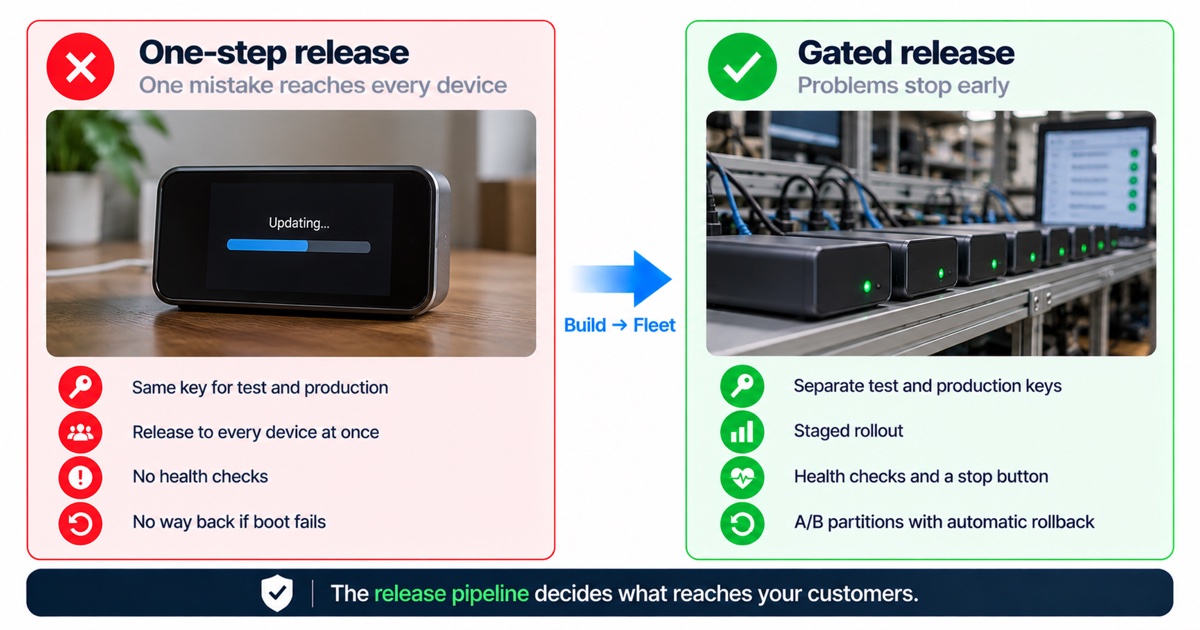
Staged rollout
Every release goes to our own devices first, then to a small share of the fleet, then to everyone. Each stage is a chance to see real behaviour before the next group of devices receives the update.
Health checks and a stop button
After every stage, devices report back: did they boot, connect and run normally? If the numbers look wrong, anyone on the team can stop the rollout.
A/B partitions and automatic rollback
Devices keep two system partitions. A device that fails to boot the new version falls back to the previous one by itself, without anyone visiting it.
Timing
We never start a rollout right before a weekend or a holiday, when fewer people are watching and fewer are available to respond.

OTA deserves its own design review
Update systems are often added late, after the product works. That is backwards. Signing, partitioning, rollout stages and rollback all depend on decisions made in the bootloader, storage layout and backend. Reviewing the update pipeline as its own part of the architecture is cheaper than learning these lessons on a live fleet.
How we can help
Our teams design and review update pipelines before they reach a fleet: signing, staged rollout and rollback, based on running OTA for our own devices in the field. To review yours, talk to an engineer.
Source: What happened to Samsung’s fridges (Android Headlines).