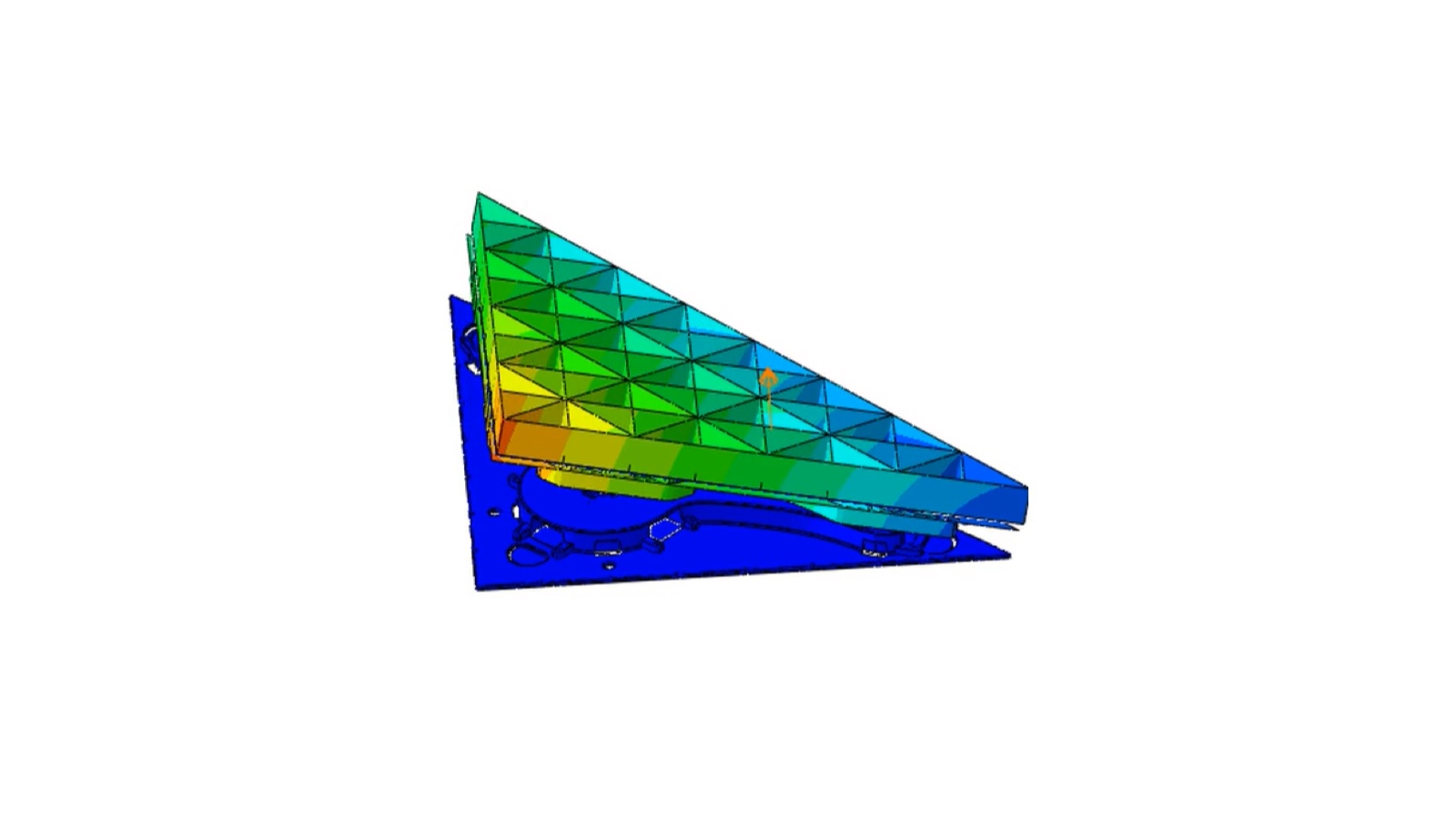
Summary: Most mechanical questions on a connected device are answered faster by printing the next prototype than by building a simulation. A few are not: forces that must happen in a set order, failures you can’t test on a bench, parts with expensive tooling, and heat. On LaMetric SKY, FEA on the wall-mount hooks saved us 5 to 10 rounds of prototypes.
The question behind every mechanical change
A clip doesn’t hold. A snap fit cracks after a few hundred cycles. A housing gets warm next to the LED driver. Each time, the team has two options: model it, or change the CAD and print another part.
Printing usually wins. An overnight print answers most questions about fit and feel for the cost of some filament. A finite element analysis (FEA) model takes time to set up, needs material data you may not have, and is only as good as its boundary conditions.
But some questions are expensive to answer with prototypes, and slow too. Those are the ones worth simulating first.
What happened on LaMetric SKY
LaMetric SKY is a modular light: panels you arrange on the wall in any shape. Each panel hangs on a base plate, and the base plate is stuck to the wall with adhesive.
That gives two requirements that pull against each other:
- The user has to be able to pull a panel off the wall, to move it or rearrange the layout.
- When they do, the base plate has to stay on the wall. If it comes off with the panel, it may take some paint with it, and the adhesive is used up.
So the hooks between panel and plate had to be balanced: strong enough to carry the panel, but releasing clearly before the adhesive lets go of the wall. The order of the two forces matters more than either value on its own.
That is a force balance, and prototypes are a slow way to find it. Every attempt needs real moulded or printed parts, a fresh adhesive bond that has had time to cure, and a wall you don’t mind damaging. Printed parts also behave differently from the final moulded plastic, so a print that “feels right” proves little.
We built an FEA model of the hook, pulled the panel off in the simulation and read the release force from the curve. Then we changed the hook geometry, ran it again and repeated until the release force sat clearly below what the adhesive holds. Only then did we build prototypes, to confirm the result on a real wall.
By our count, that saved 5 to 10 rounds of prototypes, each of which would have needed parts, a cured bond and a wall test.
When FEA earns its time
Simulate first when the question looks like one of these:
- Two forces must stay in a set order. Hooks, snap fits and clips that have to release before something else gives: an adhesive, a solder joint, a connector, a thin wall.
- Failures you can’t easily test on the bench. Drops, fatigue over thousands of cycles, and plastic creeping under a constant load over months. A bench test takes weeks; a model shows where the stress concentrates in hours.
- Parts with expensive tooling. Once the mould is cut, one more iteration means a tool change. Checking stiffness, wall thickness and rib layout in a model before the tool is made is cheap insurance.
- Heat. A hot spot near a battery, an LED driver or a display. Thermal simulation tells you early whether the enclosure needs vents, a heat spreader or a different layout, before you have a board to measure.
When the next prototype is cheaper
Skip the model and print when:
- The part prints overnight and the question is fit or feel. Does the button travel feel right, does the lid close, does the cable reach.
- The answer depends on what a model gets wrong. Real hands, cable routing, assembly order, tolerances stacking up across several suppliers.
- You have no reliable material data. A simulation with guessed properties is only as good as the guess. If you can’t get data for the exact plastic grade, a physical test tells you more.
A rule of thumb
If you would need more than two or three prototypes to find the answer, or a wrong answer means a new mould, simulate first. If one overnight print answers the question, just print it.
Whichever you choose, close the loop: a simulation should end with a prototype that confirms it, and a prototype that surprises you is often the best reason to build a model.

How we help
Our mechanical engineers design enclosures, mounts and mechanisms for connected devices, and decide with you where a simulation pays off and where a print is faster. See our enclosure and mechanical design service. If a part of your product is on its third or fourth prototype round, talk to an engineer.